
We have made it to year 10 of the American Kestrel Nest Box project in the greater Sax-Zim Bog ecosystem! There have been some changes with the project: from new data collection resources to new volunteers, to a larger number of boxes on the landscape, to challenges with technology, but we are always excited for the return of American Kestrels to the greater Sax-Zim Bog ecosystem. These charismatic raptors grace the hay meadows, open wetlands, and roadsides of our area in very good numbers, hopefully due to our efforts in supporting habitat and giving these cavity nesters a place to lay their eggs year in and year out.
Last year was one of the more difficult years for kestrels in our area, for one reason or the other. We had our lowest nest success rate ever, had the highest number of nest failures, and banded one of the lowest numbers of chicks during the run of this project. That means only one thing… next year can only be better! And, reader, it certainly was much, much better!
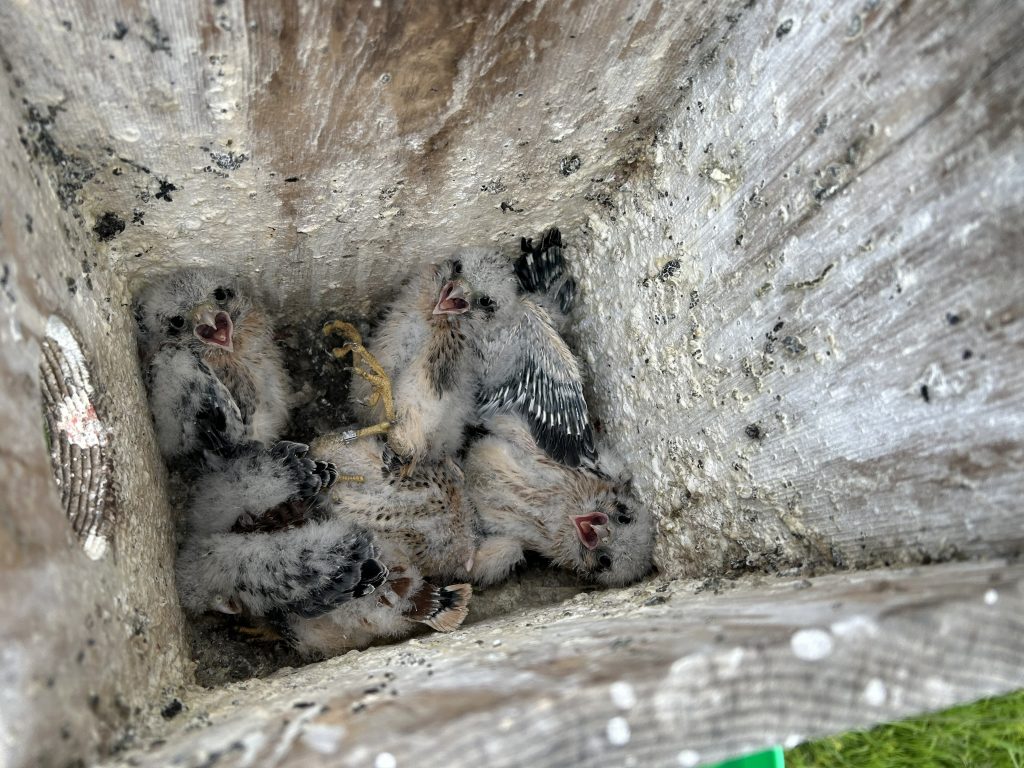
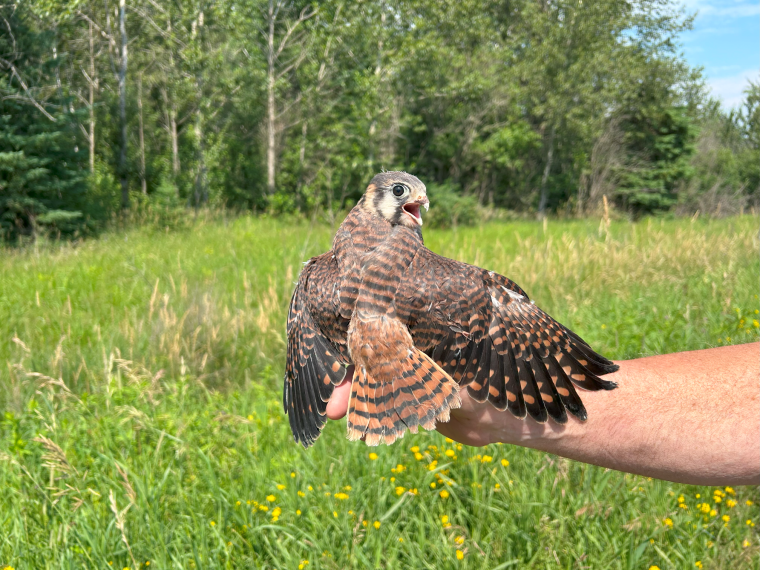
This year saw some surprises to be sure, but the biggest surprise were the positives. We had 34 boxes occupied this year (a record by 2); we banded chicks from 28 boxes (a record by 2); and banded the greatest number of chicks ever with 109 (a record by 4)! This was only the 2nd time we have ever banded more than 100 nestlings in a season. To date, we have now banded 623 American Kestrel nestlings as part of our project.
Another welcome positive for this year was only 6 nest failures. While 6 failed nests might seem like a lot, it is half as many as last year (11 total failures!). Of the failed boxes, only 2 were abandoned with the other 4 predated. We had our first confirmed nest predation by American Marten this season (based on tracks on the box!), with raccoon also being confirmed.

Where there are highs, there are surely to be lows. And I am happy to report only a scant few lowlights for the season. The biggest low on the season was our first confirmed road killed nestling. In all my years in the Bog, I have never seen a road killed American Kestrel and was saddened to find one along Arkola Road, which was a nestling hatched this year and banded only a week prior. Perhaps the most interesting lowlight would be the high number of “below average” boxes. We had a total of 8 boxes that fledged 3 or fewer chicks, with 6 of those boxes fledging 2 or fewer chicks. This is a very surprising number and likely will be the greatest number of “below average” boxes in one season.
Speaking of data, this is year 10 of the project, which means it is time to write up what we have learned for publication! Stay tuned for this process to be completed. One of the most important things about long-term projects is to review and revisit after a few years. Writing about process and results is also important to us and it will be exciting to share with you all what we have learned in total from the project so far. This year also means we have a chance to revisit box locations on the landscape and we will likely be removing a fair number of unused boxes from the landscape.

Looking back on 10 years of a single project is very exciting and I am glad to be able to share this project with all of you through these blog posts! If you would like to hear more about this project in person, I will also be doing a talk as part of the Summer Friday Speaker Series at the Lois King Education Center in the Welcome Center on August 29th of this year, reviewing the project and sharing some highlights of what we have learned with all of you. We hope to see you there!
As always, we could not continue this project without the support of our volunteers who are collecting and enter data, taking time out of their days and weeks to help conserve these amazing birds! Thank you to Jean and Susan; Nona, Sue, and Brian; Jeri and Josef; Jessica and Dawn; Kelly; and Steve! We appreciate your efforts!
Until next time, we will see you in the Bog!
— Head Naturalist Clinton